Global Equities
Markets Poised as Fed Decision and Forward Guidance Shape 2025 Rate Expectations
From our perspective, we maintain a cautious but engaged stance ahead of this week’s Federal Reserve decision.
Stock markets worldwide: indexes, sector moves, flows and positioning.
From our perspective, we maintain a cautious but engaged stance ahead of this week’s Federal Reserve decision.
Chinese e-commerce merchants are significantly expanding their presence in Russia’s online marketplaces, capitalizing on the void left by Western companies.
The re-election of President Donald Trump introduces both challenges and opportunities for Australian mining and energy companies, prompting strategic recalibrations to navigate the evolving global landscape.
The S&P 500's 0.2% decline and Nasdaq's 0.4% loss highlight the market's sensitivity to earnings guidance and sector-specific challenges. Adobe’s significant drop (-11%) on weak revenue guidance underscores the vulnerability of tech stocks to growth concerns.
The November CPI rose by just 0.2% year-over-year, missing the 0.5% forecast and further signaling deflationary pressures.
The finalization of the EU-Mercosur free trade agreement marks a significant milestone in international trade, with wide-ranging implications for global economic dynamics, geopolitical alliances, and sustainability efforts.
The South Korean won weakened sharply to $1,425, its lowest level since October 2022, reflecting heightened political and economic uncertainty.
U.S. stock futures are steady following a strong November, where major indices posted gains between 5.7% and 7.8%, with the Dow and S&P 500 reaching all-time highs.
The latest developments in U.S. equity, currency, and bond markets reflect a mix of optimism around policy stability under the incoming administration and cautious adjustments to monetary policy expectations. Below is our perspective.
Our perspective on European markets highlights the growing challenges posed by geopolitical risks, trade policy uncertainty, and economic headwinds, which are impacting key sectors and shaping investor sentiment.
The week begins with a positive tone in U.S. equity futures, but the focus shifts toward key economic data and policy developments that could influence markets over this holiday-shortened trading week. Below is our perspective on the market.
Given the current market behavior, our perspective focuses on the implications of sector rotation, policy developments, and macroeconomic data on portfolio positioning.
Given the mixed dynamics in U.S. markets, our perspective highlights the importance of balancing risk exposure across equities, fixed income, and safe-haven assets as investors navigate evolving economic, geopolitical, and policy uncertainties.
Despite a cautious start due to escalating tensions between Ukraine and Russia, the S&P 500 and Nasdaq rebounded on optimism in tech and retail sectors
Nasdaq 100 futures gained as markets await Nvidia's earnings, with significant attention on updates regarding demand for its Blackwell AI chips.
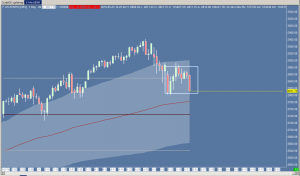
On the daily interval, the market has worked its way back into the Quarter's developing value area, which could signal a bearish shift.
U.S. equities saw significant losses on Friday, with the S&P 500, Dow, and Nasdaq reversing earlier post-election gains.
The dollar index (DXY) held at 106.9, reflecting market confidence in Trump’s economic policies and expectations of inflationary pressure from higher tariffs and deficit spending.
Our market observation highlights the need for a cautious stance on European equities, considering multiple headwinds from political uncertainty, inflation risks, and global trade tensions.
A balanced strategy in U.S. equities, fixed income, and currency exposures, considering the implications of a pro-growth, inflationary outlook under a potential Trump presidency and an anticipated shift in Federal Reserve policy is our current perspective.
Given the strong market response to the recent election outcome and the Federal Reserve’s rate cut, our perspective focuses on balancing optimism with prudent positioning, as market sentiment reflects both political and economic factors.
Our perspective highlights the implications of the ongoing U.S. presidential election results, congressional control, and upcoming Federal Reserve decision on asset allocation and risk management strategies.
Our perspective emphasizes a cautious yet strategic approach, considering the dual impact of the impending U.S. presidential election and anticipated Federal Reserve policy adjustments on market performance.
Our perspective view reflects cautious optimism in U.S. equities, while carefully monitoring signals from macroeconomic data, Federal Reserve policy expectations, and political risks.