
Our perspective on European markets highlights the growing challenges posed by geopolitical risks, trade policy uncertainty, and economic headwinds, which are impacting key sectors and shaping investor sentiment.
European markets are trading lower, with the STOXX 50 and STOXX 600 posting declines amid renewed concerns over global trade following Donald Trump’s tariff threats. The auto sector is particularly vulnerable, given its significant exposure to export markets. Key players like VW, BMW, and Daimler are among the hardest hit, reflecting heightened risks for Europe’s manufacturing sector. Broader declines in stocks like Anheuser-Busch and Siemens indicate that trade uncertainty is impacting market sentiment beyond autos.
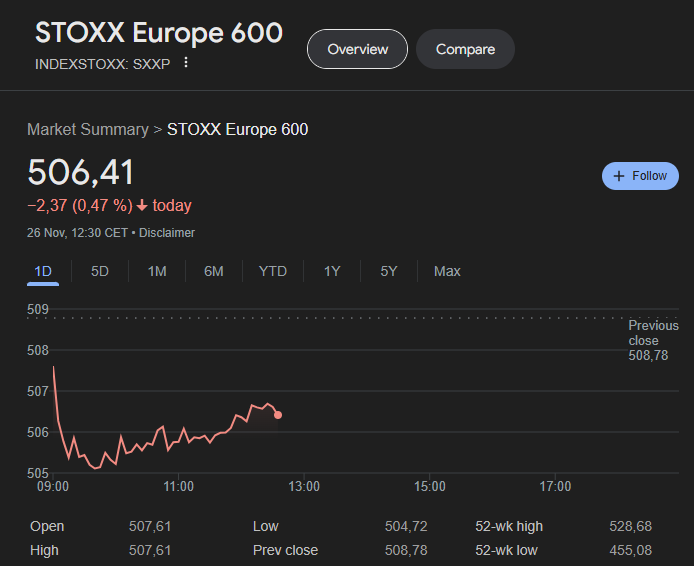
Trump’s proposal to increase tariffs—10% on China and 25% on Mexico, Canada, and potentially European goods—raises significant risks for Europe, particularly its export-reliant industries. Tariffs on European cars would exacerbate existing challenges for the region’s struggling manufacturing sector, compounding the impact of weak demand and supply chain pressures. Markets are recalibrating expectations, as initial optimism around Scott Bessent’s Treasury nomination fades under the weight of Trump’s tariff rhetoric.
Persistent economic challenges in Europe, including renewed contractions in private sector activity as reflected in PMI data, are weighing on growth prospects. The possibility of significant tariffs adds to this bleak outlook, pushing investors to increase bets on aggressive ECB monetary easing. A 25-bps rate cut in December is fully priced in, while the probability of a larger 50-bps cut has climbed to 58%. Preliminary inflation data due this week will be pivotal in shaping expectations for the size of the ECB’s rate cut.
The euro’s modest recovery to $1.05 reflects cautious optimism but remains constrained by economic uncertainty and the risk of trade conflicts. Meanwhile, the yield on Germany’s 10-year Bund has fallen to 2.2%, the lowest in about a month, as investors seek safety amid deteriorating economic conditions and rising trade risks. The bund market reflects expectations of further ECB easing, driven by weak demand and geopolitical instability.
Strategic Implications
The underperformance of Europe’s auto and manufacturing sectors warrants caution in these industries, given their sensitivity to global trade risks. Diversifying equity exposure toward less trade-sensitive sectors such as utilities or healthcare may provide relative stability. Investors should also consider defensive, high-dividend-yielding stocks to navigate the current volatility.
Falling Bund yields and rising expectations of aggressive ECB easing support a bullish view on European sovereign debt, particularly in core markets like Germany. Allocating to longer-duration bonds may help capture yield compression as rate cuts loom. However, credit spreads in corporate debt markets could widen for trade-sensitive sectors like autos, underscoring the need for careful credit selection.

The euro remains vulnerable to downside risks from a second Trump administration’s trade policies and economic weakness. Investors with international exposure should consider hedging euro-denominated assets to mitigate potential currency losses. Conversely, a weaker euro may benefit European exporters, though the offset could be limited by tariff risks.
This week’s Eurozone inflation data and PMI updates will be critical in shaping ECB policy expectations. Investors should also watch for further trade policy developments from the U.S., particularly any additional details around potential tariffs on European goods.
Like this article? Access highly trusted educational content and market research by investing in a membership to become part of our community.








