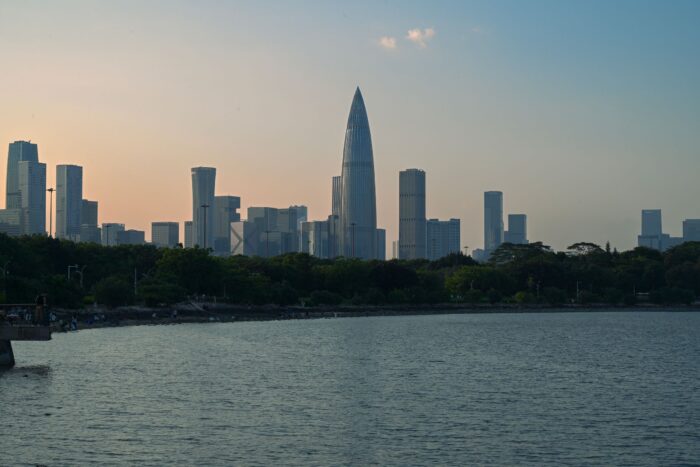
President Donald Trump said on Nov. 8 that he expects to meet Chinese President Xi Jinping and Russian President Vladimir Putin on the sidelines of the Asia-Pacific Economic Cooperation leaders’ summit in China this week, naming an end to the war in Iran and denuclearization as topics. The gathering, hosted in Shenzhen on Nov. 18-19, would be the first time the three leaders have convened together.
Beijing confirmed on Nov. 7 that it is in contact with the other parties about a meeting of the three heads of state, foreign ministry spokeswoman Mao Ning said. No agenda, format or date has been fixed. The summit brings together 21 members, including the U.S. and Russia, and would mark Trump’s third meeting with Xi this year.
The idea first surfaced publicly on Sept. 1, when Kremlin aide Yuri Ushakov said a trilateral session was possible. Kremlin spokesman Dmitry Peskov later said the concept had come up in a call between Putin and Trump, and described a Putin-Trump meeting in Shenzhen as theoretically possible. Putin has said he plans to attend, which would be his first in-person APEC summit since 2017, and Moscow wants the war in Ukraine on the table without Kyiv in the room.
Trade is the nearer deadline. U.S. Trade Representative Jamieson Greer held a video call on Nov. 6 with Chinese Vice Premier He Lifeng and urged Beijing to take concrete action to implement earlier commitments, particularly on agricultural purchases, rare earths and other critical minerals. Chinese state media described the exchange as in-depth and constructive, while Beijing raised concerns about U.S. restrictive economic and trade measures. The truce between the two economies is due to lapse in January 2027.
Trump arrives with less leverage at home after the midterm election loss. Some analysts doubt the format will yield more than imagery. Craig Singleton of the Foundation for Defense of Democracies has said the meeting may be little more than a photo opportunity, while Sun Yun of the Stimson Center has said China wants the image of the occasion without bearing its costs and is unlikely to engage on Iran or Ukraine beyond general statements about peace. Danny Russel, a former State Department official, has said Putin has the most to gain.
The geopolitical backdrop has hardened in recent days. Iran sent drones toward a U.S. base in Bahrain, its first such targeting since early September, while saying a path to a deal with Washington remains open. Ukraine struck the Crimean Bridge in what Russia’s Defense Ministry described as a record drone attack, with more than 1,300 drones intercepted overnight.

The Kremlin has not formally confirmed a trilateral meeting, and the three governments have released no schedule for it.
Sources: koreatimes.co.kr, chinaglobalsouth.com, kyivindependent.com, Bloomberg.