The South Korean won weakened sharply to $1,425, its lowest level since October 2022, reflecting heightened political and economic uncertainty. The central bank’s indication of potential market stabilization measures highlights concerns about capital outflows and further currency depreciation.
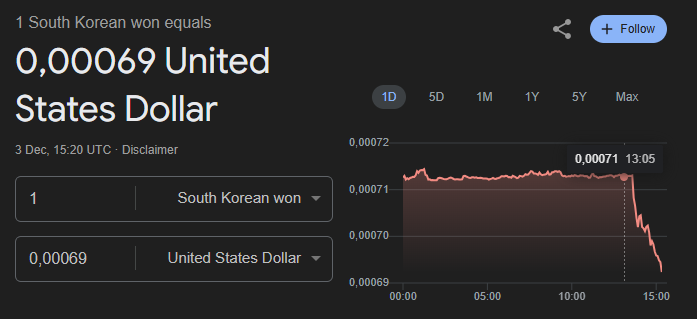
Continued weakness in the won could increase import costs, potentially stoking inflationary pressures, despite current inflation levels remaining below expectations at 1.5%.
The Bank of Korea (BoK) recently cut interest rates to 3%, the lowest level since October 2022, as part of ongoing efforts to support economic growth. However, the political instability introduced by martial law may complicate monetary policy implementation and undermine the efficacy of these cuts.
The market will closely monitor upcoming GDP figures to assess the extent of economic vulnerability. Slower growth or increased fiscal strain could lead to further pressure on the BoK to act, though its capacity may be constrained by external and geopolitical risks.
Martial law, declared for the first time since 1980, disrupts South Korea’s image as a stable democracy and introduces significant political risk. The targeting of opposition parties and suspension of parliamentary activities raise concerns about governance, rule of law, and long-term political stability.
Investor confidence may erode further, with foreign capital potentially retreating from South Korean markets. Heightened tensions in the region, particularly with the U.S. and its military presence in South Korea, could exacerbate these challenges.
South Korea’s economic and geopolitical position as a key player in the global semiconductor and electronics supply chain means that instability could have ripple effects across industries and markets. Disruption in these sectors could elevate risks for multinational corporations reliant on South Korean exports.
The U.S. response to these developments, given the presence of 28,500 American troops in South Korea, will be critical. A lack of clear communication or support may amplify uncertainty in both regional and global markets.
Strategic Implications:
The sharp depreciation of the won necessitates hedging strategies for investors with South Korean exposure. Import-reliant industries may face margin pressure, while exporters could benefit in the short term, depending on global demand dynamics.
Monitor central bank interventions, as any measures to stabilize the won could create short-term trading opportunities.
South Korean equities, particularly those in export-driven sectors like semiconductors and technology, may face volatility amid currency fluctuations and political risks. Focus on high-quality companies with strong balance sheets and diversified revenue streams to mitigate domestic risk exposure.
Reduced confidence in governance could weigh on domestic-focused sectors, particularly financials and consumer discretionary.
Political instability may lead to higher yields on South Korean government bonds as risk premiums rise. Investors should reassess duration exposure and consider diversifying into more stable sovereign debt markets.
Companies with significant reliance on South Korean supply chains should evaluate contingency plans for potential disruptions. Diversification of supply sources and inventory strategies may mitigate risks tied to prolonged instability.
Monitoring and Action Points:
- Central Bank Measures:
- Closely monitor the Bank of Korea’s interventions in currency markets and any adjustments to monetary policy to stabilize financial conditions.
- Political Developments:
- Track developments in martial law implementation, opposition responses, and potential international reactions, particularly from the U.S., China, and Japan.
- Economic Indicators:
- Pay attention to upcoming GDP figures and industrial production data to gauge the broader economic impact of political instability.
- Regional Spillovers:
- Assess potential spillovers into neighboring markets and sectors, particularly in technology, manufacturing, and defense, given South Korea’s strategic importance.
Enjoyed this article? Access highly trusted educational content and prime market research by investing in a membership.