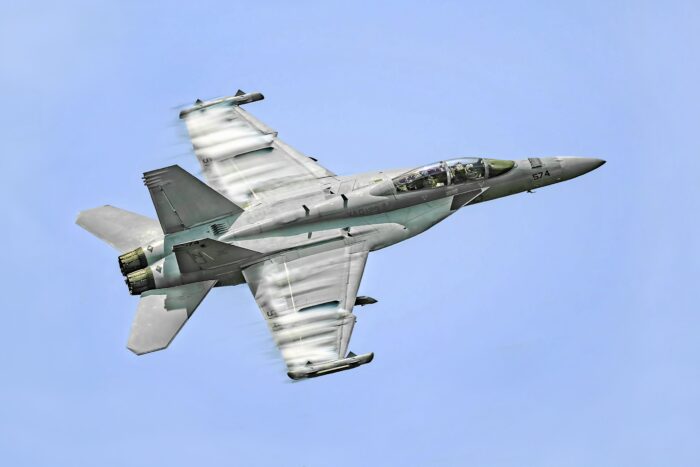
Northrop Grumman has decided not to protest the loss of the Navy’s F/A-XX fighter competition to Boeing, removing the main obstacle to a contract valued at more than $20 billion. The decision closes out a challenge that the market had treated as a live possibility since the Pentagon announced the award on the evening of Sept. 29.
The contract covers the full-scale development phase of the sixth-generation carrier fighter and buys multiple test aircraft for ground, airworthiness, systems and weapons-integration testing. The jet is meant to replace the F/A-18 Super Hornet and the EA-18G Growler. On the day of the award the Navy also gave Boeing a separate contract tied to winding down the F/A-18 E/F and EA-18G production lines.
The announcement carried no production quantities, no unit price and no delivery schedule, and the contract type has not been disclosed. The lifetime program value, often put in the hundreds of billions of dollars, is an analyst projection rather than a signed commitment. Service entry is expected in the 2030s.
For Northrop, the loss means no role as prime contractor on a crewed fighter for the first time since the F-14. The company had earlier opted out of the Air Force’s F-47 competition, which Boeing won in March 2025. Northrop shares fell 4.2% to $483.42 in the Sept. 30 session, close to a 52-week low of $479.02. Boeing was down 0.85% at $186.09 that day, after rising about 2% in after-hours trading on the announcement.
Northrop’s order book offers a cushion. Its second-quarter backlog stood at a record $104.69 billion, and it had raised 2026 sales guidance to a range of $43.75 billion to $44.25 billion. It keeps the B-21 bomber and Sentinel missile programs, along with parts of F-35 production. Analysts have said the F/A-XX loss is not existential for the company.
The case for Boeing is less settled than the headline suggests. Its Defense, Space & Security unit posted a $15 million operating loss in the second quarter on $7.48 billion of revenue, after a $280 million charge on the VC-25B presidential aircraft. Investors have pointed to pricing and contract structure, which tripped up earlier Boeing programs such as the KC-46 tanker and the T-7 trainer, as the key risks. Fixed-price development terms in particular have produced charges before, and a cost-plus structure would ease that exposure.

Boeing is also loading its St. Louis complex. The same site is expected to build the F/A-XX and the F-47, along with the T-7A and a planned increase in F-15EX output. Analysts have flagged possible workforce strain, and one defense-policy researcher said balancing early labor demand between the two fighters will have to be proactively managed. How much the F/A-XX shares with the F-47 will help determine how quickly a workable jet can be produced.
Protests of major classified aircraft awards have historically rarely succeeded, which analysts cited as one reason Northrop’s options were limited. Boeing’s defense chief has said delivering two advanced fighters in parallel was always the plan and that the company invested accordingly. The Navy has not said how many aircraft it intends to buy or what weapons the jet will carry, and officials have only said it will have greater range than current fighters.
Sources: defensedaily.com, breakingdefense.com, 247wallst.com.