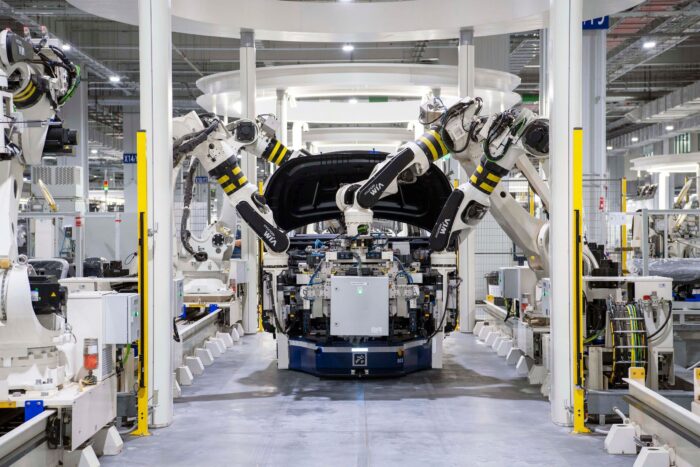
Mercedes-Benz is moving to what Chief Executive Officer Ola Källenius calls a “100% China for China” strategy, building cars for the Chinese market with local engineering and production as demand for its vehicles there contracts sharply.
The electric Mercedes E-Class will be the first model produced under the plan, with output scheduled for the second half of next year. Källenius said the earlier hybrid-style model, in which parts of each car came from plants in several regions before final assembly in China, has stopped working. He also warned that pulling back from the country would be a mistake, even as Chinese buyers remain cautious.
The shift follows a weak third quarter. Mercedes-Benz car sales in China fell 31% in the period, and nine-month sales there dropped 29% to about 297,000 vehicles. Global Cars unit sales declined 8% to 407,232 vehicles, while sales outside China rose about 1%, led by gains of 5% in Europe and 6% in the United States.
Profitability at the Cars division halved. Adjusted return on sales was 2.5%, against 4.8% a year earlier, with adjusted earnings before interest and taxes of €560 million. On Oct. 28 the company lowered its full-year Cars margin guidance to a range of 2% to 3%, and management said fourth-quarter profitability should be close to break-even. Group guidance now calls for EBIT at the prior-year level and industrial free cash flow significantly below last year’s.
The group-wide picture is less bleak than the Cars numbers suggest. Group EBIT rose to €1.77 billion from €0.75 billion in the same quarter last year, and net profit increased to €1.52 billion from €1.19 billion. Revenue slipped to €30.7 billion from €32.1 billion. Financial Services adjusted EBIT climbed about 42% to roughly €445 million, and Vans posted an adjusted return on sales of 9.4% on about 84,000 units.

The China exposure has also shrunk in relative terms. The market once accounted for more than a third of Cars sales and now represents roughly a fifth. Källenius has previously said that price wars in the Chinese car market are here to stay and that domestic brands are spending heavily to push into the luxury segment.
Sources: Bloomberg, qz.com, group.mercedes-benz.com, Investing.com.