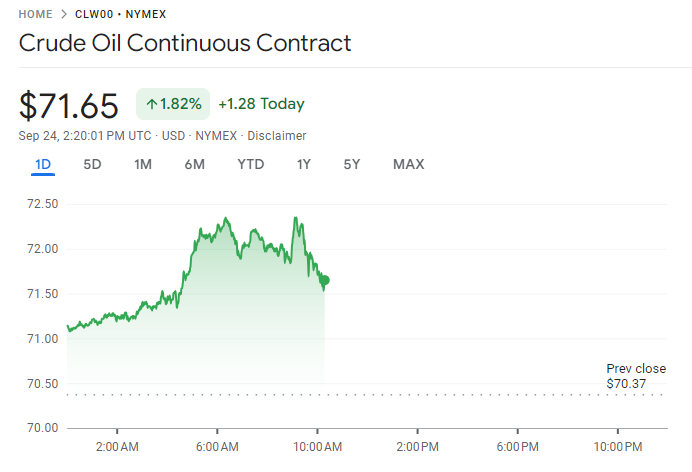
The rise in WTI crude prices reflects the market’s sensitivity to potential supply disruptions amid increasing geopolitical risks. Tensions in the Middle East, particularly the Israeli strikes on Lebanon, are driving fears of a broader conflict in the oil-producing region, which could impact supply chains. Additionally, the looming threat of a hurricane affecting the US Gulf Coast adds further uncertainty about near-term output.
On the demand side, while concerns persist about sluggish global consumption, China’s new stimulus measures aimed at stabilizing its economy may ease some of those worries, particularly given China’s role as the world’s top oil importer. However, the unexpected decline in eurozone business activity highlights ongoing demand challenges in key global markets, particularly in Europe, where both the services and manufacturing sectors are showing weakness.
Overall, while supply concerns are currently pushing prices higher, the broader outlook remains cautious due to ongoing global economic challenges and softening demand in key regions like the eurozone. Investors will likely continue to monitor both geopolitical developments and demand signals closely in the coming days.
1. Scenario: Geopolitical Risks Drive Further Price Spikes
- Key Factors: Heightened tensions in the Middle East, especially if the conflict escalates or spreads to other oil-producing regions, alongside potential disruptions from a hurricane impacting the US Gulf Coast.
- Strategy:
- Long positions on crude oil: Traders could consider increasing exposure to crude oil futures or oil-related ETFs, anticipating further price increases driven by potential supply disruptions.
- Energy stocks: Investors might look at energy companies, especially those involved in oil production, exploration, or services, which could benefit from rising oil prices.
- Oil call options: For more conservative risk management, buying call options on crude oil could provide upside exposure while limiting potential losses.
2. Scenario: China’s Stimulus Reignites Demand
- Key Factors: If China’s stimulus measures effectively boost economic activity, oil demand could rise, supporting sustained or even higher prices.
- Strategy:
- Long positions on oil and China-focused energy ETFs: As demand from China recovers, energy ETFs focused on China or emerging markets could benefit. Investors could also consider long positions on commodities or related energy equities.
- Exposure to industrial commodities: If China’s economy stabilizes, other industrial commodities like copper or steel could see demand increase, making them attractive for broader portfolio diversification.
- Consider energy sector bonds: Higher oil prices and stronger global demand could improve credit profiles of energy companies, making energy bonds an appealing yield play.
3. Scenario: Eurozone Weakness and Global Economic Slowdown
- Key Factors: If the eurozone’s economic situation worsens, and demand slows globally, this could offset supply concerns and put downward pressure on oil prices.
- Strategy:
- Hedging with short positions or put options: Traders could consider hedging against potential downside by taking short positions on oil futures or buying put options if they expect demand to falter further.
- Diversification into defensive sectors: Investors may reduce exposure to cyclical energy stocks and shift toward defensive sectors, such as utilities or healthcare, which tend to be less sensitive to economic cycles.
- Consider high-dividend energy stocks: For income-focused investors, high-dividend energy stocks might still offer attractive returns even if oil prices moderate, providing income while waiting for market stabilization.
4. Scenario: Hurricane Disruptions and Temporary Price Spike
- Key Factors: A hurricane in the US Gulf Coast could cause temporary disruptions to oil output, driving a short-term spike in crude prices.
- Strategy:
- Short-term trading opportunities: Traders could take advantage of short-term volatility by increasing exposure to oil futures or energy sector ETFs, looking for quick gains from the temporary price spike.
- Sell into strength: Investors who have been holding energy positions might consider taking profits if oil prices experience a sharp upward move, as temporary disruptions are unlikely to sustain long-term upward trends.
- Stop-loss protection: To mitigate risk in the event of a reversal, traders can set tight stop-loss orders on long positions in oil to protect gains from sudden market changes.
Like this article? Access highly trusted educational content and market research with a membership.