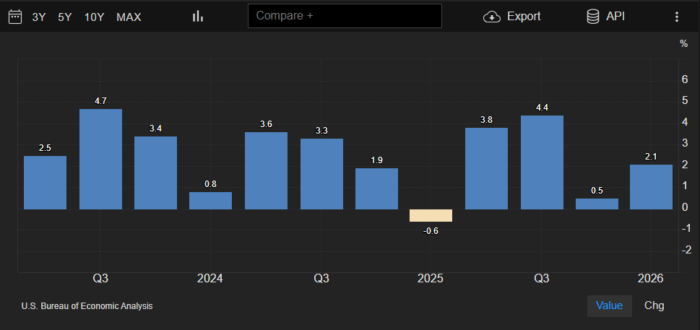
The US economy in mid-2026 operates in a hybrid regime of policy-induced resilience and reaccelerating price pressures. Real GDP rebounded to a 2.1 percent annualized pace in Q1 after a government shutdown dragged Q4 2025 growth to just 0.5 percent. The expansion draws support from the 2025 reconciliation act’s fiscal impulse and a post-shutdown release of pent-up activity, yet it contends with a sweeping tariff regime that has lifted the effective rate to roughly 11.7 percent and an energy-price shock tied to the US-Iran conflict. Inflation has reaccelerated: headline CPI reached 4.2 percent year-over-year in May and core PCE hit 3.4 percent, the highest readings in three years. The labor market shows surface stability, the unemployment rate edged down to 4.2 percent in June, but the June payroll gain of only 57,000 jobs and a sharp 720,000 contraction in the labor force reveal a deeper participation collapse linked to immigration restrictions. The federal funds rate sits at 3.50–3.75 percent under new Chair Kevin Warsh, with markets now pricing a high probability of at least one hike by September.
Three highest-conviction conclusions follow. First, the dominant narrative of a clean “soft landing” understates the regime’s fragility: growth is policy-supported rather than organic, and the labor-market slack is concentrated in reduced supply rather than weak demand, setting up potential wage and capacity pressures once immigration flows stabilize. Second, capital flows into US assets remain robust and private-sector driven—net foreign purchases of long-term securities exceeded $150 billion in March alone and totaled a record $1.55 trillion for 2025, financing large fiscal deficits even as official institutions show greater caution. This “private bid” for US equities and Treasuries has kept the S&P 500 up roughly 10 percent year-to-date and the 10-year Treasury yield near 4.5 – 4.6 percent, masking underlying tensions between protectionist policy and continued foreign appetite for dollar assets. Third, the single most under-appreciated risk is a stagflationary tilt if the Iran-related energy impulse proves persistent and tariff pass-through continues to exceed 50 percent while labor-force participation stays depressed; the most under-appreciated opportunity lies in sectors insulated from tariff retaliation yet positioned to benefit from domestic investment incentives and AI-driven productivity gains.
Sophisticated allocators should therefore treat the current configuration as a high-conviction but narrow window: maintain core exposure to US growth assets while shortening duration in fixed income, favoring USD over most G10 crosses, and selectively rotating toward domestic capital-expenditure and reshoring beneficiaries. The regime rewards patience on policy clarity and punishes premature bets on either rapid disinflation or outright recession.
As of early July 2026 the US macro picture reflects the cumulative effects of three overlapping policy shocks that began in late 2025: a sweeping tariff regime implemented via executive authority, a temporary lapse in discretionary appropriations that produced a government shutdown in October–November 2025, and a sharp tightening of immigration enforcement that has reduced net labor-force inflows. These developments sit atop a still-elevated but normalizing post-pandemic baseline and an ongoing AI investment cycle.
Growth in the first quarter surprised to the upside at 2.1 percent annualized once revisions incorporated lower import growth and stronger equipment spending. The rebound was mechanically aided by the reversal of shutdown-related distortions, yet underlying private domestic demand has moderated. Consumer spending slowed markedly in Q1, particularly in services, while business investment in structures contracted. Government spending provided an offset, consistent with the reconciliation act’s tax and expensing provisions that took effect in 2025.
Inflation dynamics have deteriorated more than consensus anticipated six months ago. The May CPI print of 4.2 percent year-over-year was driven overwhelmingly by energy, gasoline prices surged more than 40 percent in the twelve months through May amid the Iran conflict, while shelter and food components also accelerated. Core measures have followed: core CPI at 2.9 percent and core PCE at 3.4 percent mark multi-year highs. Recent news of an interim US-Iran arrangement and falling oil prices may ease the headline impulse in coming months, but tariff-related price pressures are still working their way through supply chains with a lag.
The labor market’s apparent resilience conceals a supply-side adjustment of unusual speed. The June employment report showed a meager 57,000 payroll gain and a drop in the unemployment rate to 4.2 percent only because the labor force itself shrank by 720,000, the second-largest monthly decline since the pandemic. The labor-force participation rate fell to 61.5 percent, its lowest level since March 2021. Prime-age participation has held up better, but the aggregate decline aligns closely with the timing and scale of immigration-policy changes. This is not classic cyclical slack; it is a reduction in potential labor supply that compresses the economy’s speed limit even as demand remains supported by fiscal measures.
Financial conditions remain accommodative relative to the inflation backdrop. The 10-year Treasury yield has traded in a 4.4–4.6 percent range in recent sessions, the S&P 500 has delivered roughly 10 percent total return year-to-date, and the DXY has firmed above 101. Foreign private investors continue to absorb large volumes of both US equities and Treasuries, providing the financing that allows the Treasury to run elevated deficits without immediate crowding-out pressure on domestic rates.
Three structural forces dominate the current regime and generate effects that extend well beyond first-round impacts.
The tariff regime functions less as a simple tax on imports and more as a relative-price shock that redistributes activity across sectors and borders. Pass-through estimates now exceed 50 percent, implying a persistent 1 percentage point or greater lift to core inflation over the medium term. Second-order consequences include accelerated domestic capital expenditure in protected sectors, particularly those eligible for immediate expensing under the reconciliation act, while simultaneously raising input costs for downstream manufacturers and retailers. The net effect on aggregate investment is ambiguous: reshoring incentives pull capital inward, yet higher uncertainty and retaliation risks deter marginal projects. Supply-chain reconfiguration is already visible in inventory builds and shifts in sourcing patterns, but these adjustments are capital-intensive and time-consuming, creating a temporary drag on productivity before any eventual gain materializes.
Fiscal policy under the reconciliation framework has provided a meaningful demand impulse through lower individual income taxes and enhanced business expensing. This support has helped offset tariff drag and the shutdown’s legacy effects. However, the combination of higher structural deficits and reduced immigration is altering the economy’s supply side in ways that conventional models understate. Lower net migration directly reduces labor-force growth and, over time, potential output. It also concentrates wage pressure in lower-skill segments where participation has fallen most sharply. The interaction with tariffs is particularly potent: protectionism raises the return to domestic labor in tradable sectors while immigration restrictions reduce the supply of that labor, creating a classic supply-constrained demand boost that is inherently inflationary.
Monetary policy transmission under the new Federal Reserve leadership has shifted subtly. Chair Warsh’s early communications emphasize data dependence and a shorter forward-guidance horizon than the previous regime. With inflation already above target and the labor market’s apparent slack partly illusory, the hurdle for further easing has risen materially. Any normalization of energy prices will test whether core measures can resume their prior disinflationary path or whether tariff and wage pressures keep them elevated. The balance-sheet runoff continues, but its marginal impact on liquidity is now overshadowed by the Treasury’s heavy issuance needs, which private foreign demand has so far accommodated.
These drivers interact to produce a regime in which growth can remain above potential for longer than cyclical models suggest, yet the composition of that growth becomes increasingly skewed toward protected or fiscally subsidized sectors, and the inflation risk is asymmetric to the upside.
The prevailing consensus frames the current environment as a manageable reacceleration of inflation within an otherwise resilient expansion, with the Fed retaining ample room to respond. Several strands of evidence challenge that view.
First, the labor-market data are routinely interpreted as “cooling but not broken.” The June payroll miss and participation collapse suggest something closer to a supply shock than a demand slowdown. Historical episodes in which participation fell sharply, often tied to policy or demographic shifts, have been followed by periods of wage acceleration once the economy re-engaged available workers or adjusted to the new supply level. Treating today’s 4.2 percent unemployment rate as equivalent to the same rate in 2019 ignores the compositional change in the labor force.
Second, capital-flow strength is cited as proof that the world still wants to own US assets. The record private inflows are real, yet they coexist with continued net sales or reduced accumulation by foreign official institutions. The divergence matters: private investors are responding to relative returns and perceived growth opportunities in US equities and credit; official institutions appear more sensitive to geopolitical and reserve-management considerations. A sustained private bid can finance deficits for a time, but it does not guarantee indefinite tolerance for policy volatility or rising real yields if inflation proves sticky.
Third, the tariff regime is often modeled as a one-time level shift in prices with limited second-round effects. Evidence from the first Trump administration and more recent pass-through studies indicates that tariff-induced inflation can persist and interact with domestic wage dynamics, particularly when labor supply is constrained. The current episode combines both forces. Consensus forecasts that assume rapid mean-reversion of inflation therefore embed an optimistic assumption about both energy normalization and the absence of wage-price feedback.
These contrarian elements do not imply imminent crisis. They do imply that the distribution of outcomes is fatter-tailed on the inflationary side than standard projections acknowledge, and that policy responses, whether fiscal recalibration or monetary tightening, may need to be more aggressive than markets currently price.
Surface metrics obscure several operational and incentive frictions that will shape the regime’s durability.
Tariff administration and customs processing have created bottlenecks at ports and in compliance functions that are only partially visible in aggregate trade data. Firms report extended lead times for imported components even as overall import volumes have been revised lower in GDP accounts. These frictions raise working-capital requirements and inventory carrying costs, effects that are concentrated among smaller and mid-sized manufacturers least able to absorb them.
The immigration-policy shift has produced an information asymmetry between headline labor statistics and ground-level hiring realities. Employers in agriculture, construction, and services report acute shortages that do not yet appear fully in wage data because many positions remain unfilled or are filled at higher effective costs through overtime or subcontracting. The lag between reduced inflows and observable wage pressure is lengthening, but the direction is clear once participation stabilizes.
Fiscal-monetary coordination frictions have intensified. Large Treasury issuance coincides with ongoing balance-sheet reduction and a higher-for-longer rate environment. Private foreign demand has bridged the gap so far, but any diminution in that bid, whether from shifting risk appetite or reserve diversification, would transmit directly into higher term premia or reduced liquidity in the Treasury market. The TIC data themselves contain an asymmetry: private inflows are reported with less lag and granularity than official flows, leaving investors with an incomplete picture of the sustainability of external financing.

Finally, the interaction between AI-driven productivity gains and tariff-protected sectors creates a hidden bifurcation. Productivity improvements are concentrated in a narrow set of capital-intensive, high-skill activities, while tariff and labor-supply effects are broadest in goods-producing and lower-skill services. The resulting divergence in firm-level margins and regional outcomes is not yet fully reflected in aggregate statistics or in broad equity indices.
Current asset prices embed a relatively benign view of the regime’s durability. Equity valuations, particularly in mega-cap technology, reflect expectations of sustained earnings growth and limited policy disruption. The S&P 500’s year-to-date advance of roughly 10 percent has been driven disproportionately by a handful of names, leaving equal-weighted and value indices lagging. This narrow leadership is consistent with a world in which AI capex remains the dominant growth driver while tariff and labor frictions weigh on broader corporate profitability.
Fixed-income markets price a path of one to two additional rate hikes over the next twelve months, with the 10-year yield anchored near 4.5 percent. This level is broadly consistent with current inflation readings and growth forecasts, yet it leaves little margin for error if core inflation fails to moderate after the energy impulse fades. Term premia remain compressed relative to historical norms given the fiscal backdrop, suggesting that markets continue to assign high probability to continued foreign private absorption of Treasury supply.
Currency markets reflect the same tension: the DXY near 101 incorporates both higher US real yields and the perception that policy uncertainty is manageable. Foreign private demand for US assets has supported the dollar even as official reserve managers have shown more restraint.
The clearest mispricing lies in the relative valuation of duration versus growth assets. If inflation proves more persistent than the median forecast, real yields will rise and equity multiples will compress, particularly outside the highest-conviction AI and domestic-investment themes. Conversely, if the Iran-related energy shock dissipates quickly and tariff pass-through proves one-off, the current rate path may prove overly restrictive, supporting further multiple expansion in rate-sensitive sectors. The market’s pricing of these two paths is not symmetric; the downside for bonds appears under-appreciated relative to the upside for equities.
Long-only portfolios should maintain a core overweight to US equities with a deliberate tilt toward companies benefiting from domestic capex incentives and AI infrastructure spend, while underweighting pure import-dependent consumer discretionary names. Duration should be kept short to neutral; any extension should favor inflation-protected or floating-rate instruments. Cash and short-term Treasuries retain utility as a volatility buffer given the asymmetry of inflation risk.
Hedge funds can exploit the regime’s policy and data uncertainty through relative-value strategies in rates, long front-end versus intermediate duration, or curve steepeners if fiscal dominance concerns intensify, and through single-name equity dispersion trades that capitalize on the bifurcation between AI leaders and tariff-exposed cyclicals. Volatility-selling strategies carry elevated tail risk and should be sized conservatively. Currency overlays that are long USD against commodity-linked or tariff-vulnerable crosses remain attractive on a carry-and-convergence basis.
Strategic corporate and sovereign allocators face a different calculus. Corporates with US-centric supply chains or exposure to protected sectors should accelerate domestic investment where expensing provisions apply, while hedging currency and input-cost exposure more aggressively than in prior cycles. Sovereign wealth funds and large official institutions should treat the current private bid for US assets as a tactical opportunity rather than a structural constant. Maintaining or modestly increasing exposure to US Treasuries and equities for liquidity and return reasons makes sense, but diversification into non-dollar assets and real assets should continue as a hedge against any erosion in official-sector tolerance for dollar concentration. All investor types should avoid large outright short positions in US growth assets or the dollar; the private capital inflow dynamic has proven more durable than most contrarian forecasts anticipated.
What to avoid: crowded recession-hedge positioning in long-duration bonds or defensive equities, and any assumption that labor-market data will continue to signal ample slack without corresponding wage or price effects.
The US macro regime in mid-2026 is best understood not as a standard late-cycle expansion but as a policy-shaped equilibrium in which fiscal and trade interventions are actively altering both demand and supply. Growth remains supported, capital continues to flow toward US assets on a private basis, and equity markets have absorbed the uncertainty with relative composure. Yet the underlying frictions, constrained labor supply, lagged tariff effects, and an energy impulse that may or may not prove transitory, create an inflation bias that is under-reflected in both consensus forecasts and current asset pricing. The investor who internalizes this configuration will position for resilience with an explicit hedge against its most probable deviation: a higher and more persistent inflation path than the median projection assumes. That mental model, more than any single data point, separates durable capital allocation from reactive positioning in the quarters ahead.








