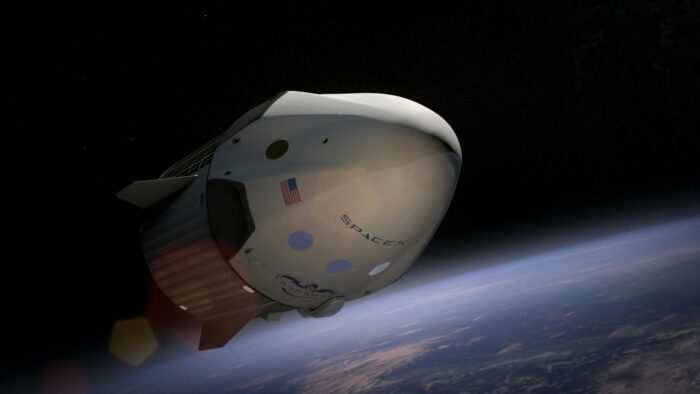
SpaceX has set a fixed offering price of $135 per share for what is poised to become the largest initial public offering in history, targeting a raise of approximately $75 billion and a post-deal valuation near $1.77 trillion to $1.8 trillion. The move, disclosed in a Wednesday SEC filing ahead of a rapid roadshow, positions Elon Musk’s rocket, satellite, and AI infrastructure giant for a Nasdaq debut under ticker SPCX as soon as June 12.
The pricing implies roughly 555.6 million shares sold, eclipsing Saudi Aramco’s 2019 record. At that level, SpaceX would instantly rank among the world’s most valuable public companies, surpassing Tesla’s current market capitalization and reflecting explosive growth in Starlink broadband, reusable launch capabilities, and ties to the artificial-intelligence compute boom.
Musk, who controls about 42% of the equity and a commanding voting stake, stands to see his personal fortune swell further, potentially pushing him closer to trillionaire status across his portfolio of public companies. The IPO comes after SpaceX’s February merger with his xAI startup, which had already lifted its private valuation to $1.25 trillion.
Proceeds will fund Starship development, Starlink constellation expansion, and AI-related infrastructure, including large GPU cluster deployments. The company has highlighted partnerships and demand from hyperscalers seeking reliable, high-bandwidth connectivity and orbital computing capacity to support massive training runs. Starlink generated the lion’s share of 2025’s $18.7 billion in revenue, though the company still posted net losses amid heavy capital spending.
Wall Street’s enthusiasm is palpable. The fixed-price structure, unusual for a deal of this scale, bypasses traditional book-building and signals Musk’s confidence in strong retail and institutional demand. A significant portion of shares is reportedly earmarked for employees, friends-and-family, and retail investors, broadening the ownership base.
Yet the listing also spotlights governance questions. Musk will retain outsized control, dual roles across Tesla and SpaceX, and a long lockup on his stake, raising familiar concerns about execution risk in a multi-company empire.
Skeptics have a point on multiples. At $1.8 trillion, SpaceX would trade at roughly 95 times trailing revenue, far above most industrial or tech peers. Analysts such as Morningstar have pegged fair value closer to $780 billion, citing execution risks and competition.
Success or stumbles in the first weeks of trading will ripple across markets. A strong debut could embolden other private tech and space unicorns to accelerate exits, while validating Musk’s dual-public-company model. Weakness might cool retail enthusiasm for mega-cap IPOs and refocus attention on profitability metrics.

For investors, the IPO represents both opportunity and concentration risk. Allocations will be hotly contested, with secondary trading likely to reflect ongoing Starship test flights, Starlink metrics, and any Musk-Tesla crossover news.
SpaceX’s orbit into public markets marks more than a record fundraising event, it crystallizes the convergence of space, defense, telecom, and AI into a single investable mega-theme. Whether the valuation holds will depend less on today’s financials and more on execution in the decade-long race to dominate off-world infrastructure. Wall Street is chasing the orbit; the question is whether gravity eventually asserts itself.
Enjoyed this article? Access highly trusted training content and expand your horizon towards advanced wealth creation by investing in a membership.