
U.S. equities saw significant losses on Friday, with the S&P 500, Dow, and Nasdaq reversing earlier post-election gains. Technology and pharmaceutical stocks led the declines, as Powell’s hawkish comments tempered optimism for near-term rate cuts, and speculation about Robert F. Kennedy Jr. heading HHS added pressure to healthcare names. For the week, the major indices posted sharp declines, signaling heightened investor caution amid shifting monetary and policy dynamics.
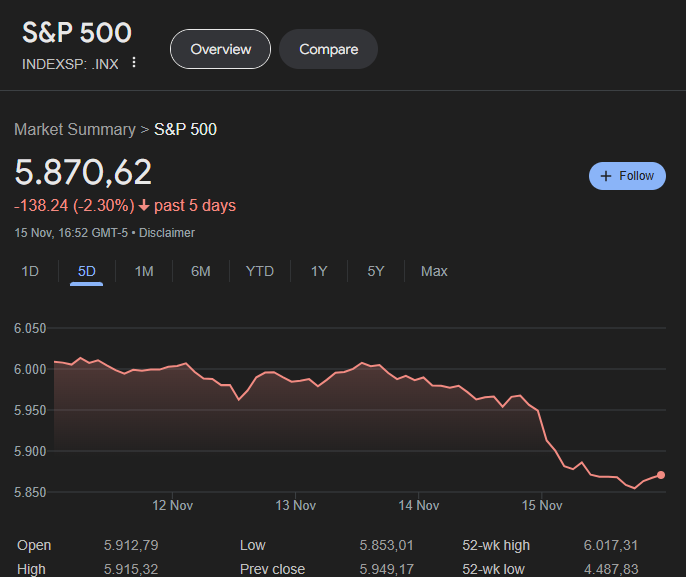
Stronger-than-expected retail sales growth (+0.4%) and a surprise surge in the NY Empire State Manufacturing Index underscore the U.S. economy’s resilience, even as restrictive interest rates persist. This economic strength, coupled with robust labor market indicators, provides the Fed with justification to maintain a cautious approach to rate cuts, supporting Powell’s comments about inflation risks and the lack of urgency to ease policy.
The dollar index slipped slightly to 106.5 but remains near 2-year highs, supported by strong economic data and hawkish Fed guidance. Treasury yields followed suit, with the 10-year yield holding at 4.45%, close to multi-month highs. These movements reflect market expectations that the Fed’s cutting cycle will likely end around 4%, up from previous forecasts of 3%, signaling a higher-for-longer rate environment.
Pro-inflationary risks tied to the Trump administration’s anticipated policies, including tariffs and fiscal expansion, are adding complexity to the Fed’s calculus. Persistent price pressures may limit the central bank’s flexibility, as Powell’s cautious approach highlights the need to balance growth with inflation control.
Strategic Implications:
The broad-based selloff, particularly in technology and healthcare, underscores the need for defensive equity positioning. Focus on value-oriented sectors, such as utilities and consumer staples, may provide stability amid market uncertainty. For technology and growth sectors, a selective approach emphasizing companies with strong balance sheets and resilient earnings is advisable, given the sensitivity of these sectors to higher rates and policy uncertainty.
With the Fed signaling a slower pace of rate cuts and Treasury yields remaining elevated, maintaining a shorter duration in fixed-income portfolios is prudent. Inflation-linked bonds (TIPS) may offer protection against inflationary risks tied to Trump’s policies, while high-quality credit could provide attractive income opportunities as yields remain elevated.

The strong dollar presents headwinds for U.S. exporters and companies with significant international exposure. Hedging currency risk for global portfolios may mitigate the impact of dollar strength. Additionally, selective exposure to non-U.S. equities and emerging markets should account for potential currency volatility and diverging central bank policies.
Upcoming economic releases, including inflation and labor market data, will be pivotal in shaping rate expectations. Powell’s cautious stance underscores the importance of closely monitoring shifts in Fed rhetoric and adjusting portfolios in response to any changes in the trajectory of monetary policy.
Enjoyed this article? Access highly trusted educational content and market research by investing in a membership.








