
Our market observation highlights the need for a cautious stance on European equities, considering multiple headwinds from political uncertainty, inflation risks, and global trade tensions.
European stocks are under pressure, with the STOXX 50 and STOXX 600 declining further after Tuesday’s sell-off. Concerns about U.S. policies under Trump, particularly potential tariffs targeting European exports, have cast a shadow over Europe’s export-heavy sectors. Major names like Bayer, ASML, SAP, and Volkswagen have suffered losses, reflecting heightened sensitivity to external risks in healthcare, technology, and auto manufacturing. At the same time, corporate news has driven individual stock performances, with positive movements in RWE, Siemens Energy, and Just Eat Takeaway demonstrating selective resilience within the European market.
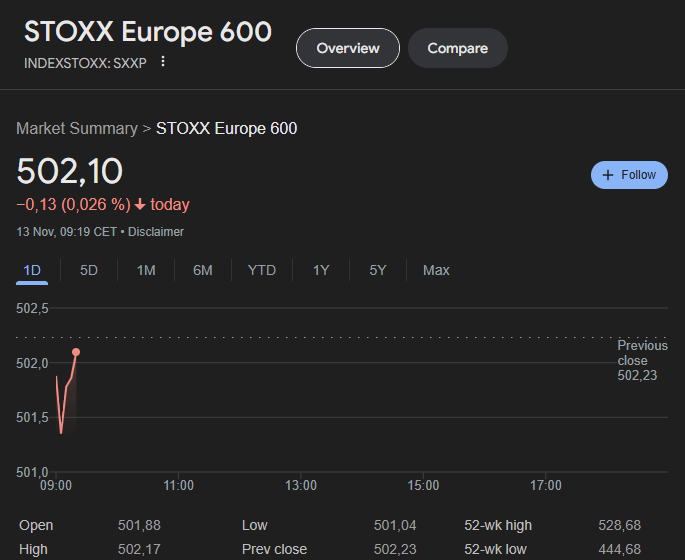
Political challenges within the Eurozone, particularly in Germany, add a layer of complexity. The recent collapse of Chancellor Scholz’s coalition and the announcement of early elections in February have introduced political uncertainty, affecting investor sentiment and weighing on the euro, which has fallen below $1.06. Additionally, Trump’s comments suggesting trade tariffs could be levied against the euro bloc have exacerbated concerns around trade conflicts, particularly for European carmakers, creating downside pressure on the euro and further strengthening the dollar.
Weaker-than-expected economic sentiment in Germany, as reflected by the sharp drop in the ZEW Indicator, points to persistent economic challenges in the Eurozone’s largest economy. This, coupled with lackluster PMI data across key Eurozone economies, reinforces expectations that the European Central Bank (ECB) will proceed with a 25-bps rate cut in December. The recent decline in the German 10-year Bund yield to 2.3%, following last week’s highs, reflects growing expectations for a more dovish ECB stance in response to weaker economic conditions and subdued inflation.
With U.S. inflation data due, markets are bracing for any signals that could influence both the Federal Reserve’s and ECB’s policy directions. The stronger dollar and rising U.S. Treasury yields contrast sharply with the softening German Bund yields, highlighting the diverging economic outlooks between the U.S. and Eurozone. A high inflation print in the U.S. could strengthen the dollar further, posing additional challenges for European exporters.
Strategic Implications:
Given heightened economic and political risks, a cautious approach to European equities is advisable. Reduced exposure to export-sensitive sectors, such as autos and industrials, can help manage risks tied to potential trade conflicts with the U.S. Selective positioning in resilient sectors, such as utilities (e.g., RWE) and financials with strong fundamentals, may provide stability. Defensive, high-dividend stocks could also offer downside protection as the economic and political environment remains uncertain.
The softening of German Bund yields and expectations for further ECB rate cuts support a defensive duration strategy within European fixed income. Increasing exposure to Eurozone sovereign debt, particularly in shorter to medium durations, may help capture returns amid falling yields. Additionally, inflation-protected securities could offer stability if inflation moderates further and the ECB adopts a dovish approach.
With the euro under pressure against a strengthening dollar, currency hedging is advisable for portfolios with significant foreign exposure. For U.S.-based investors in European assets, hedging euro exposure can help mitigate currency risk amid dollar strength. For those in European markets, exposure to dollar-denominated assets may offer a hedge against regional political and economic volatility.

Trade relations between the U.S. and Eurozone are under close scrutiny, with potential tariff implications for sectors such as autos and industrials. Additionally, U.S. inflation data will provide critical insights that could affect global central bank policy expectations. Staying agile and ready to adjust based on incoming data will be crucial, particularly for sectors highly sensitive to inflation and rate changes.
Amid political uncertainties, potential trade tensions, and economic softness in Europe, a balanced approach to European equities, selective fixed-income positioning, and currency hedging will help manage portfolio risks. Monitoring key data releases and policy developments will allow for responsive adjustments as the global macro landscape continues to evolve.
Like this article? Enjoy access to highly trusted educational content and market research by investing in a membership to become part of our community.








