Xiaomi Corp. introduced the Xring O3 system-on-a-chip on Monday, a 3-nanometer mobile processor designed for improved artificial intelligence performance and power efficiency in its flagship devices. The Beijing-based company stated the chip advances its semiconductor efforts with more efficient image processing and distributed AI acceleration across the CPU, GPU, ISP, DPU and ADSP. Founder Lei Jun noted via WeChat that the silicon uses a 3-nanometer fabrication process, positioning it near the node employed for Apple Inc.’s recent A19 Pro chips and ahead of Huawei Technologies Co.’s current in-house designs.
Taiwan Semiconductor Manufacturing Co. will produce the Xring O3, according to people familiar with the matter. The chip packs 24 billion transistors, a 26 percent increase from its predecessor, on a 133-square-millimeter die. It features a 10-core CPU configuration with peak clocks reaching 4.35 gigahertz, delivering up to 60 percent higher performance, and a 16-core G2-Ultra NX GPU that Xiaomi said provides as much as 85 percent greater graphics performance with 64 percent better efficiency. Memory support includes LPDDR6 at speeds up to 10,667 megabits per second and bandwidth of 113.8 gigabytes per second, a 48 percent rise over the Xring O1. AI capabilities reach 200 TOPS of tensor performance and 3.13 TFLOPS of vector performance, with NPU throughput up 45 percent. Xiaomi reported an AnTuTu score of 5.22 million, the first mobile SoC to exceed 5 million points. Development spanned 459 days.
The Xring O3 will debut in the Xiaomi 18 Fold foldable phone and the Pad 9 Pro Max tablet, both scheduled for launch in China in September. Shipment targets for the initial folding-phone run range from 200,000 to 300,000 units, per one source. Xiaomi also announced the Xring O100, a 6-nanometer 3D wafer-on-wafer stacked AI accelerator for large models with bandwidth up to 1.22 terabytes per second, and the Xring D100, a 3-nanometer smart-driving chip with a 20-core CPU, 16-core NPU and support for up to 160 gigabytes of unified memory capable of running models with as many as 200 billion parameters locally. Both the O100 and D100 have completed validation and are slated for commercial use in 2027. The D100 is described as China’s first high-computing-power smart-driving chip on a 3-nanometer process.
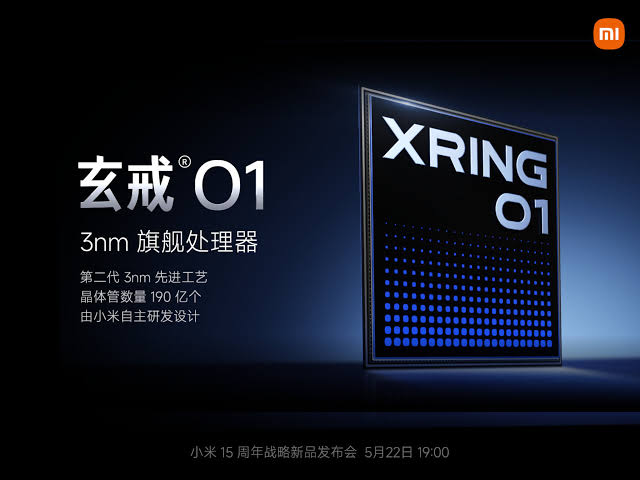
Xiaomi has invested more than 21 billion yuan, or about $3.1 billion, since restarting its chip program and employs a team of nearly 3,000 experts. Cumulative shipments of devices powered by the earlier Xring O1, launched in May 2025, surpassed 1 million units across smartphones, tablets and watches. The company continues to use Qualcomm Inc. and MediaTek Inc. processors in other models while expanding self-designed silicon.

Although the announcement is framed as a direct challenge to Qualcomm and MediaTek’s dominance in Android flagships, the Xring O3 remains on a 3-nanometer node while some rival designs are advancing toward 2-nanometer processes. Xiaomi’s first-generation Xring O1 shipments included roughly 150,000 smartphones since its 2025 debut, indicating that in-house silicon still accounts for a limited portion of overall device volume. The O3’s architecture continues to rely on Arm public IP for core elements and external manufacturing at TSMC, consistent with the approach used by other non-Apple designers rather than fully proprietary transistor-level development. Benchmark leadership on AnTuTu does not automatically translate to sustained real-world superiority across all workloads, particularly modem integration and sustained cellular efficiency where integrated solutions from established suppliers retain advantages.
Xiaomi’s chip team has grown to nearly 3,000 specialists, supporting parallel development of mobile, AI-acceleration and automotive silicon within the same program. The Xring O3’s static latency is rated at 82 nanoseconds, a figure the company describes as industry-leading. Prior cumulative investment reached approximately 13.5 billion yuan by early 2025 before the additional outlays that brought the total past 21 billion yuan. The O1 already demonstrated commercial viability with more than 1 million devices shipped, providing a production baseline for the higher-volume O3 ramp. The D100’s ability to handle 200-billion-parameter models locally positions it for on-device AI in vehicles without continuous cloud dependence, a capability aligned with Xiaomi’s expanding electric-vehicle lineup. Memory bandwidth of 113.8 gigabytes per second on LPDDR6 represents a first for any mobile SoC according to company disclosures.