
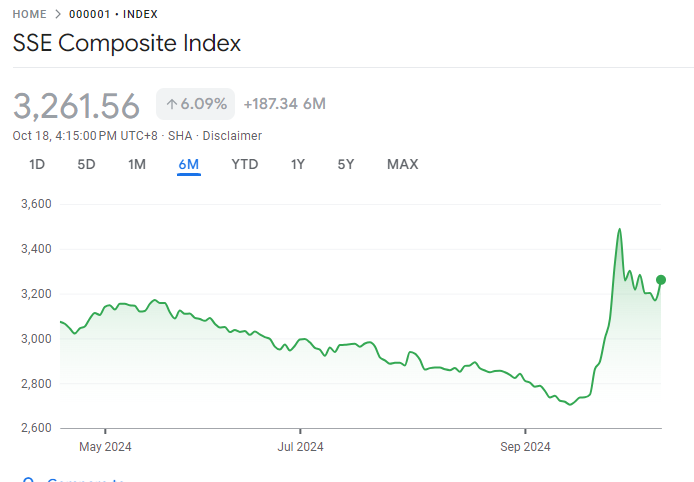
GDP Growth and Economic Expansion:
The country’s GDP growth rate increased to 0.9% in September, up from 0.7% in the previous quarter, demonstrating steady economic expansion. On an annual basis, however, GDP growth eased slightly to 4.6% from 4.7%. While this deceleration is minimal, it is important to watch for any signs of slowing momentum in the coming quarters, particularly given the volatile global economic environment.
Employment and Inflation Trends:
The unemployment rate continued to decline, reaching 5.1% in September from 5.3%, signaling a healthy labor market. This is approaching pre-pandemic levels, suggesting sustained job creation. Inflation, on the other hand, remains subdued, with the annual inflation rate decreasing to 0.4% from 0.6%, and the month-over-month inflation rate stagnating at 0%. Low inflation offers a favorable environment for consumers and businesses, though it raises concerns about deflationary pressures, especially as wage growth and demand remain relatively weak.
Monetary Policy:
The central bank maintained its key interest rate at 3.35%, signaling a cautious stance despite the favorable inflation environment. With the cash reserve ratio lowered to 9.5%, down from 10%, the central bank aims to provide more liquidity to the banking system and stimulate lending. This balance between managing inflation and ensuring liquidity suggests a wait-and-see approach amid uncertain global economic conditions.
External Trade and Current Account:
The balance of trade recorded a slight surplus of $81.71 billion, down from $91.02 billion, but still reflecting a solid external sector performance. The country’s current account surplus expanded significantly to $545 million, up from $392 million, driven by robust export growth and stable import levels. However, the current account to GDP ratio fell to 1.5% from 2.2%, indicating a need to maintain vigilance in external sector management to avoid long-term imbalances.
Government Debt and Fiscal Policy:
Government debt as a percentage of GDP increased to 83.6% from 77.1%, marking the highest level on record. However, fiscal consolidation efforts have yielded improvements in the government budget deficit, which narrowed to -5.8% of GDP, a significant improvement from -7.4%. These trends suggest that the government is balancing its fiscal responsibilities while continuing to invest in economic recovery efforts.
Business and Consumer Confidence:
Business confidence showed a slight improvement, rising to 49.8 points from 49.1, indicating that sentiment among business leaders remains cautiously optimistic. However, the Manufacturing PMI declined to 49.3, indicating a contraction in the sector, while the Non-Manufacturing PMI remained flat at 50. These indicators suggest a mixed outlook for the economy, with certain sectors facing headwinds. Consumer confidence remained stable at 85.8 points, indicating that consumers are not significantly more pessimistic, despite subdued inflation and slower growth.
Retail Sales and Taxation:
Retail sales showed modest growth, increasing by 0.39% month-over-month, up from 0.02% previously. This slight recovery in consumer spending could help sustain economic momentum, although continued improvements will be necessary for more robust growth. Taxation rates remain unchanged, with corporate tax set at 25% and personal income tax at 45%, maintaining the status quo for businesses and households.
Potential Scenarios and Strategic Considerations:
1. Upside Scenario:
- If inflation remains low and the economy continues its steady growth, we could see stronger consumer spending and business investments. The central bank’s liquidity measures and fiscal policies may spur further economic activity, driving stock market gains. In this case, sectors like retail, technology, and infrastructure could benefit from increased demand and government support.
2. Downside Scenario:
- A potential downside risk arises from slowing global trade and weakened demand from major trading partners. This could lead to declining exports and a contraction in manufacturing output, reflected in the declining PMI. A global slowdown or geopolitical tensions could exacerbate trade deficits, negatively affecting the current account balance and dampening economic growth prospects.
3. Base Scenario:
- Under a base scenario, the economy is likely to continue its moderate growth trajectory, with stable inflation and employment rates. The central bank may maintain its current monetary policy stance to support further expansion without overheating the economy. Gradual fiscal adjustments and debt management will be necessary to sustain long-term growth while avoiding excessive government borrowing.
The current economic data presents a cautiously optimistic outlook, with steady GDP growth, a recovering labor market, and low inflation. However, mixed signals from business confidence, declining manufacturing activity, and external trade challenges suggest that continued vigilance is needed. Investors should focus on sectors with strong domestic demand and companies well-positioned to weather potential external shocks. Strategic fiscal and monetary interventions, along with sustained business and consumer confidence, will be critical to ensuring that the economy remains on a stable growth path into 2025.
1. Scenario: Steady Economic Growth with Low Inflation
- Investment in Domestic Consumption and Retail: China’s GDP growth rate of 0.9% (quarterly) and 4.6% (year-on-year) suggests steady, if not spectacular, growth. With inflation at a very low 0.4% and consumer confidence remaining stable (85.8 points), the environment is favorable for consumer spending.
- Strategy: Invest in consumer-focused sectors, especially e-commerce, retail, and consumer goods. Companies benefiting from rising consumer spending, such as leading retail and food delivery platforms, are likely to perform well. A focus on domestic consumption-oriented stocks, especially in high-growth urban regions, can offer sustained returns.
- Trading: Look at Exchange-Traded Funds (ETFs) that track the consumer discretionary sector in China, or invest directly in leading Chinese consumer brands. Companies with strong digital presence, logistics networks, and innovative product offerings will outperform in this environment.

2. Scenario: Downturn in Manufacturing and Global Trade Risks
- Diversification into Defensive Stocks and Safe-Haven Assets: The contraction in China’s manufacturing sector, as indicated by the Manufacturing PMI drop to 49.3, combined with global trade uncertainties, poses a risk to industrial output and export-driven businesses. Furthermore, the Balance of Trade surplus has shrunk, signaling potential external sector weakness.
- Strategy: Diversify into defensive sectors like utilities, healthcare, and consumer staples, which typically perform well during economic slowdowns. Given that China’s economy is transitioning towards a more service-oriented structure, defensive stocks are less vulnerable to trade shocks.
- Trading: Invest in companies that provide essential services or basic consumer goods. Safe-haven assets like gold or government bonds may also serve as hedges against volatility. Investors could consider China-focused bond ETFs, which provide exposure to government securities that tend to perform well during periods of uncertainty.
3. Scenario: Long-Term Growth Through Technology and Innovation
- Investment in Technology and Green Energy: Despite short-term challenges, China remains committed to long-term structural reforms, particularly in the technology and green energy sectors. With steady GDP growth and strong government support for innovation, sectors such as 5G technology, artificial intelligence (AI), electric vehicles (EVs), and renewable energy present strong long-term growth opportunities.
- Strategy: Invest in companies leading the innovation charge, particularly those involved in advanced manufacturing, green technologies, and digital infrastructure. China is heavily investing in its digital economy and transitioning toward sustainable energy sources, making these sectors highly attractive.
- Trading: Consider investing in technology and clean energy-focused funds, or direct investments in leading Chinese tech giants and EV manufacturers. Exposure to companies involved in battery technology, solar power, and wind energy could provide significant growth opportunities over the next decade.
4. Scenario: Government Support for Infrastructure and Domestic Investment
- Real Estate and Infrastructure Investment: With the Chinese government focusing on maintaining economic stability and reducing its debt-to-GDP ratio (currently at 83.6%), there may be renewed efforts to stimulate domestic investments, particularly in infrastructure projects and real estate. Additionally, the central bank’s liquidity measures (lowering the cash reserve ratio to 9.5%) could boost lending to the real estate sector.
- Strategy: Real estate investments, especially in high-demand urban centers, could see appreciation as the government encourages infrastructure growth. The reduced interest rates also make mortgage financing more affordable, boosting the housing market.
- Trading: Invest in real estate investment trusts (REITs) focused on Chinese property markets, particularly in growing urban areas where infrastructure spending is robust. Alternatively, infrastructure-focused funds could benefit from long-term government-backed projects, such as high-speed rail, urban development, and renewable energy installations.
5. Scenario: Stable Interest Rates and Low Corporate Tax
- Corporate Bonds and Fixed-Income Securities: With the interest rate remaining steady at 3.35% and the corporate tax rate holding at 25%, businesses are operating in a stable fiscal environment. This provides an opportunity to invest in corporate bonds, as companies with stable cash flows will likely continue to offer attractive yields.
- Strategy: Allocate capital to investment-grade corporate bonds and fixed-income securities, particularly from companies with strong balance sheets and consistent profitability. Low inflation combined with a stable interest rate environment makes fixed-income investments attractive, especially for conservative investors seeking steady returns.
- Trading: Explore corporate bond ETFs or directly invest in bonds from well-established Chinese firms with strong credit ratings. These offer stable income and lower risk compared to equities, especially in a low-interest-rate environment.,
Enjoyed this premium economic research? Access highly trusted market research and educational content by investing in a membership.








