[level-wealth]
For institutional traders, the volume profile serves as a crucial tool to decode market dynamics and anticipate price movements. Within this framework, low volume areas hold a special place, offering valuable insights into potential trading opportunities and risks. This article delves into the significance of low volume areas on the volume profile and explores strategies institutional traders employ to navigate these zones effectively.
Unveiling Low Volume Areas: What Are They?
Low volume areas, often referred to as trading voids or thin markets, represent regions on the volume profile chart characterized by minimal trading activity. These areas stand out as voids amidst higher trading volumes, indicating periods when price did not attract significant market participation. Such voids can occur for various reasons, including low market interest, lack of liquidity, or market pauses.
The Significance for Institutional Traders
Institutional traders keenly observe low volume areas as they can reveal hidden insights and potential price reactions. Here’s why these areas are of interest:
- Price Pivot Points: Low volume areas can act as pivot points for prices. When price revisits these zones, it often encounters less resistance or support due to the absence of significant past trading activity.
- Breakout and Reversal Zones: These areas can serve as potential breakout or reversal zones. A sudden surge in trading volume within a low volume area could signal a breakout, while a change in market sentiment might trigger a reversal.
- Liquidity Pockets: Institutional traders monitor low volume areas for potential liquidity pockets. If a high-volume move occurs near a low volume area, it could indicate a trap for market participants, leading to swift price reversals.
Strategies for Navigating Low Volume Areas
Institutional traders employ several strategies to navigate low volume areas effectively:
- Confirmatory Signals: Traders often seek confirmatory signals, such as candlestick patterns or technical indicators, to validate potential price movements within low volume areas.
- Volume Expansion: A sudden increase in trading volume within a low volume area could signal an imminent price movement. Traders watch for volume expansion as a potential precursor to a breakout or a reversal.
- Price Rejection: If price approaches a low volume area and experiences strong rejection, it could indicate a significant level of supply or demand, potentially leading to a reversal or consolidation.
- Wait-and-Watch Approach: Institutional traders may adopt a wait-and-watch approach within low volume areas, as these zones can be unpredictable. They monitor price behavior closely and enter trades with caution.
- Risk Management: Due to the inherent uncertainty of low volume areas, risk management is crucial. Institutional traders manage their positions with well-defined stop-loss levels to mitigate potential losses.

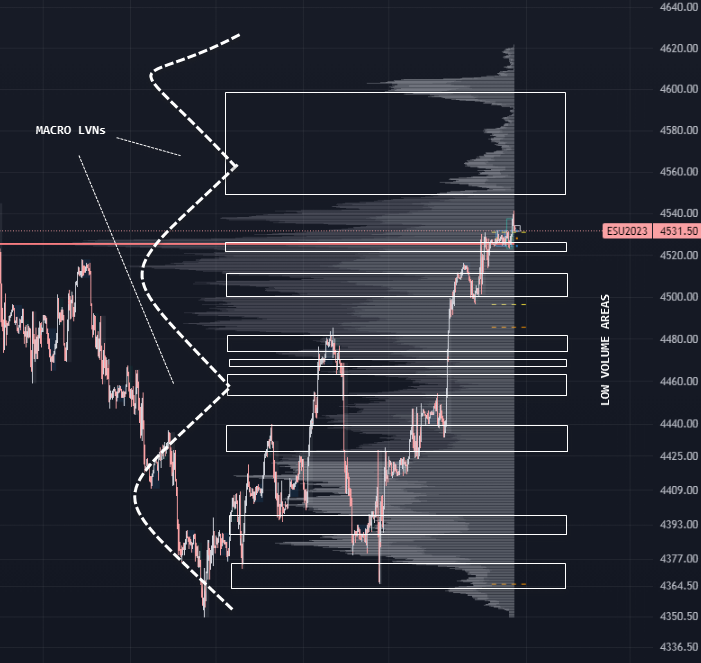
While we often refer to low volume areas as potential zones of support and resistance, they often serve as targets for position liquidation or covering. These areas become focal points for potential price balance. In the illustration below, you can see several instances of low volume areas where the market could establish balanced rotations to fill those areas with volume, using the extremes as areas of interest. It’s worth noting that these target areas tend to be more effective when they align with other levels from various tools, such as the developing or closing VWAP levels. Again, low volume areas are frequently viewed as zones to target for closing positions, either partially or entirely, as positions are opened.
Summary
Low volume areas on the volume profile offer institutional traders unique insights into market dynamics. These areas can act as pivot points, breakout zones, or liquidity pockets. Effective navigation of low volume areas involves employing confirmatory signals, monitoring volume expansion, observing price rejections, and practicing prudent risk management. As institutional traders decode these trading voids, they gain a competitive edge in anticipating price movements and making informed trading decisions.
[/level-wealth]