- US stock futures exhibited declines, with Dow Jones contracts falling approximately 190 points, while the S&P 500 and Nasdaq 100 also dropped around 0.4%. Bank shares were particularly affected by Moody’s credit rating cuts for 10 smaller and midsize banks, with potential downgrades for larger banks looming.
- Bank of New York Mellon and US Bancorp saw premarket trading losses of about 2.3%, and Truist Financial lost 2.2% after being placed under review for possible downgrades.
- Italy’s unexpected imposition of a 40% levy on banks’ extra profits and weaker-than-expected trade data from China intensified risk-averse sentiment among investors.
- UPS shares sank over 5% in premarket trading following the company’s revision of its 2023 revenue and margin forecast. On the other hand, Eli Lilly experienced a surge of over 10% after surpassing profit expectations and raising its full-year earnings outlook.
- The dollar index edged higher to 102.4 due to concerns about the banking sector’s health and disappointing trade data from China, leading to a flight to safety.
- Moody’s credit rating downgrades for smaller and midsize US banks highlighted growing profitability pressures and potential capital generation challenges amid a looming mild recession.
- Italy’s imposition of a 40% levy on banks’ extra profits and weaker trade data from China contributed to the global risk aversion.
- Government bond yields, including the US 10-year Treasury note yield, retreated below 4%, driven by apprehensions about the banking sector’s stability.
- Market participants anticipate the release of the US Consumer Price Index (CPI) report for insights into ongoing price pressures in the economy. The Treasury Department’s upcoming sale of $103 billion in coupon-bearing debt is also being closely monitored.
Analyzing the daily interval, we can discern the presence of a prior inside bar as the market nears its lows, potentially indicating a setup for absorption, which could prompt buying activity during the New York trading session.
The previous profile demonstrates a balanced structure, with the market trending lower. This hints at a potential bearish imbalance, though a potential return to the previous price range could encourage traders to leverage the extremes for upward rotations, contingent upon forthcoming economic data.
The session is experiencing pressure from a higher dollar, coupled with positive volatility, which could attract additional buyers to the market.
The market’s closing scenario may unfold in two ways: an inside day failure, pointing toward higher prices in the next session, or an inside day break lower, which could trigger further selling and a subsequent downside rotation.

Taking a look at the COT report, it’s notable that dealers and the leveraged sector (funds) appear inclined toward the selling side of the market while in the latest week with short covering behavior. The asset manager sector seemingly maintains a net long position.
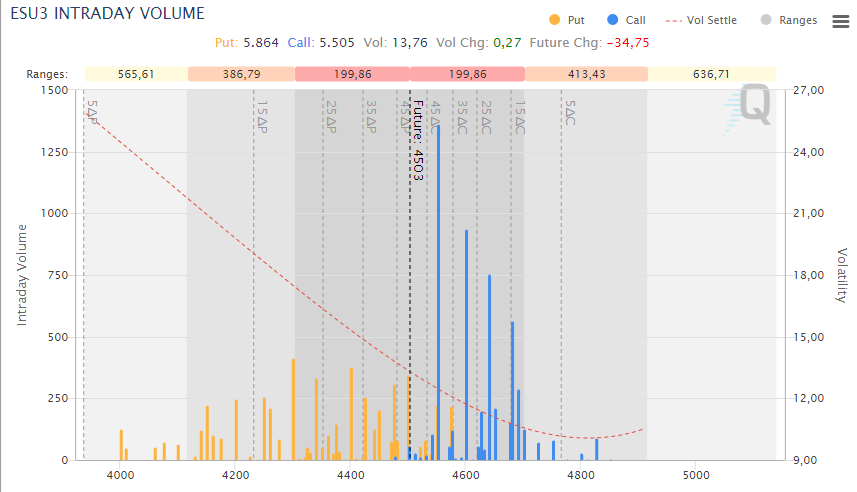
An overview of options volume suggests a current interest in higher prices in the E-mini S&P 500 ESU3 contract, although this sentiment might shift in the hours ahead.