
The European central bank raised three key interest rates by about 50bps during its July meeting. The main refinancing rate is now at 0.5%, the marginal lending facility at 0.75% and the deposit facility one at 0.00%. The higher interest rates are set in place to fight the surging inflationary pressure. Hikes in interest rates commonly are supportive for the currency while the euro keeps its decreasing behavior against the dollar for several months. Main reason might be the interest rates gap between other global central banks which are hiking at a faster and higher pace, hence traders see the dollar as a safe-haven asset to buy which pressures the euro lower. Any hints of additional hikes might be supportive for the European currency.
Money supply M1 to M3 is still rising while the central bank’s balance sheets shows a decrease which might be supportive.
Pressure factor for the euro is the often mentioned surging inflation rate which stands around record highs at 8.9%, mainly due to the rising energy costs while the latest reports shows prices accelerated for food, alcohol & tobacco the most with 9.8% vs 8.9% in June. The recent monthly data show an increase of 0.1% vs 0.8% which might be beneficial for the short-term intervals. Any easing of the inflation rate is eventually leading to a supportive behavior to buy euros against dollars.
The unemployment stays unchanged around 6.6% which has actually decreased since months, showing growth by the supportive monetary policy for higher demand in the past years which drove the equities sector higher, including prices. Higher production might be able to fight inflation and may keep the rate at the current low of the particular YoY interval to support the euro currency.
Industrial and manufacturing production data showing an increase in the latest releases while the Business confidence and Manguacruing PMI showing a decrease since months which should be a pressure factor for the euro. The slightly higher production data might support to ease inflationary pressure.
Retail sales disappointed with falling data which might be able to ease inflationary pressure by lower demand to support the euro despite the common knowledge that higher sales increase the value of a currency by higher usage of it.

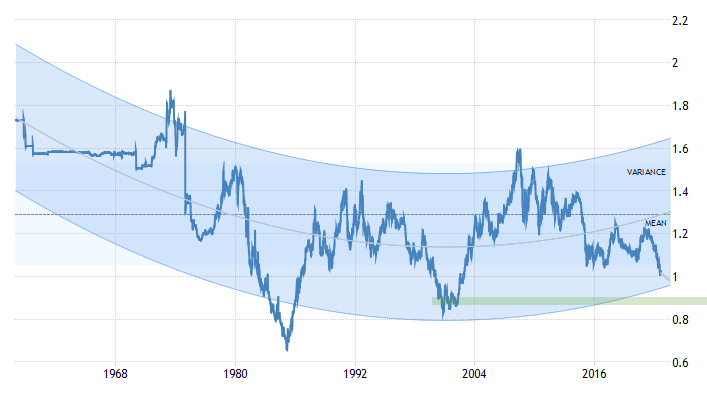
The decade’s view on the euro against the dollar hitting the lower standard deviation level which might be supportive to lead the currency into a balanced behavior. The ultra-macro view still has room to the downside towards the lower value extreme of the historical price range. Current forecasts pointing to the downside, according to calculations and analysts estimates. However, the current analysis on the Quarter’s view might be able to find supportive euro buying around the lower value extreme around 1.01 for the dollar. The currency week’s lower value level might be supportive in today’s session while the recent inflation data might be a pressure factor.
Like this article? Subscribe to trusted and indepth educational modules to gain an additional edge in the financial markets.